Table of Contents The 5 Stages of Palliative Care: An Amara Hospice Care Guide The 5 Stages of Palliative Care How Multidisciplinary Care Teams Support Each Stage The Role of a Multidisciplinary Care Team Across Stages Pain and Symptom Management Strategies Holistic Support: Emotional and Spiritual Care Navigating Palliative Care for Your Loved One: Practical …

Table of Contents
- The 5 Stages of Palliative Care: An Amara Hospice Care Guide
- The 5 Stages of Palliative Care
- How Multidisciplinary Care Teams Support Each Stage
- Navigating Palliative Care for Your Loved One: Practical Steps
- Addressing Complex Symptoms and End‑Stage Palliative Care
- Palliative Care Questions Answered
- Embracing Comfort and Dignity with Amara Hospice Care
The 5 Stages of Palliative Care: An Amara Hospice Care Guide
Understanding what the 5 stages of palliative care are begins with recognizing that palliative care is a specialized medical approach focused on comfort, symptom relief, and quality of life for individuals with serious illness. These five stages form a compassionate framework that guides care from diagnosis through end-of-life support, addressing physical, emotional, and practical needs.
It is important to understand that palliative care is not the same as curative care. The distinction is in the level of emphasis placed on the individual as opposed to the disease. While it is useful to delineate care into the five stages, the focus is truly on the individual’s needs, both physical and emotional. At Amara Hospice Care, we appreciate the five stages as an essential guide through the unfamiliar terrain of care decisions. This is especially helpful when families and caregivers have to make complex decisions about care; we ensure patients receive coordinated, multidisciplinary support, and our team works closely with loved ones to tailor care to each individual’s values and goals.
With 24/7 on-call availability and a dedicated staff of physicians, nurses, social workers, and chaplains, we surround patients with comfort and dignity through every phase. By coordinating care across medical, emotional, and spiritual dimensions, we strive to make each stage manageable and meaningful. We are honored to serve families across Saginaw, Southfield, and the greater Detroit area.
We invite you to explore each of these five stages and how Amara Hospice Care supports you and your family at every step.
Key Takeaways
- Each stage of the palliative care journey calls for a unique blend of expertise, making a multidisciplinary team essential for comprehensive support.
- The multidisciplinary team you’ve assembled provides the foundation for navigating the practical aspects of palliative care with confidence.
- Palliative care provides comfort and symptom management for people with serious illness, regardless of the stage of the illness.
- We are now able to address the issues which are of greatest importance to you, your family and loved one.
The 5 Stages of Palliative Care
To understand what are the 5 stages of palliative care, it helps to view the progression as a flexible framework. Unlike curative treatment, palliative care can begin at diagnosis and run alongside other therapies. At our hospice, we walk alongside patients and families through each phase with caring and compassionate hospice services rooted in a mission of grace.
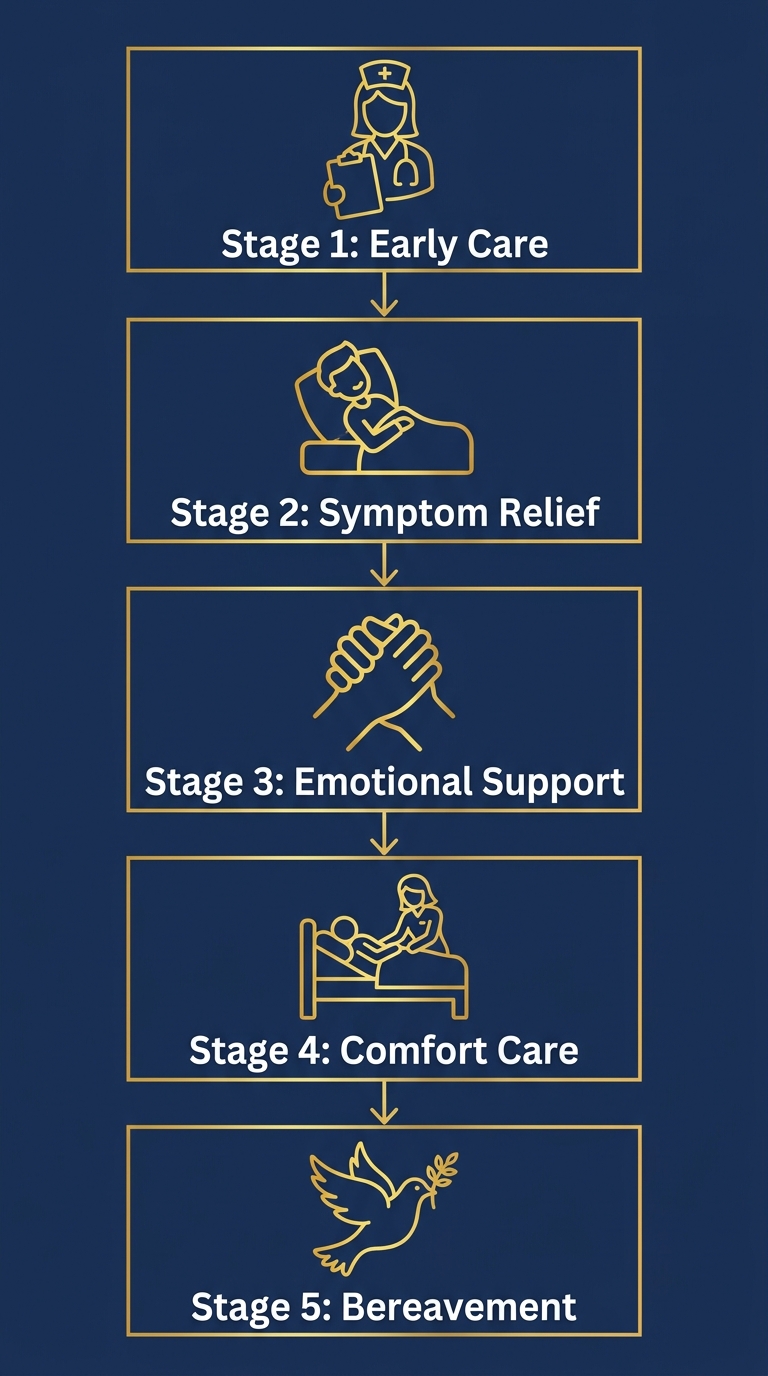
What are the levels of palliative care? This question generally focuses on the degree of medical support. The five stages highlight the emotional and clinical milestones of support. The five stages are as follows:
- Stage 1: Initial planning and early care. At diagnosis, our nurses and social workers help you establish care goals, complete advance directives, and create a personalized plan. We begin light symptom management and introduce volunteer companionship so that you never feel alone, even during active treatment.
- Stage 2: Active symptom relief. As illness advances, comfort becomes the priority. Pain management specialists work alongside massage and music therapists to ease discomfort. Our 24/7 on-call team ensures that if symptoms intensify unexpectedly in Saginaw County or the Greater Detroit area, a clinician can adjust your care plan promptly.
- Stage 3: Emotional and psychosocial support. Palliative care addresses the whole person, so this stage deepens emotional and spiritual care. Chaplains, social workers, and trained volunteers offer counseling and companionship. Family members receive psycho-social services to cope with caregiving strain, while recreation and music therapy bring moments of connection and joy.
- Stage 4: Comfort-focused end-of-life care. In the final weeks, we shift entirely to dignity and comfort. Nurses administer medications to minimize pain and agitation, and aides assist with personal daily living. Massage and music therapy continue to soothe, ensuring the patient’s environment remains calm whether at home or in a facility.
- Stage 5: Bereavement and family healing. Support continues after a loss. Our bereavement team, chaplains, social workers, and volunteers, provides counseling, memorial planning, and support groups. We help loved ones navigate grief while honoring the patient’s memory, ensuring that the family’s well-being remains central to our caring and compassionate approach.
Across all five stages, coordinated support from our multidisciplinary team ensures that patients and families never face the journey alone. This team-based approach naturally weaves together medical, emotional, and spiritual care at every step.
How Multidisciplinary Care Teams Support Each Stage
Each stage of the palliative care journey calls for a unique blend of expertise, making a multidisciplinary team essential for comprehensive support.
The Role of a Multidisciplinary Care Team Across Stages
Our team includes physicians, registered nurses, certified nursing aides, physical, occupational, and speech therapists, social workers, chaplains, and trained volunteers. We serve families in Saginaw, in Southfield, and throughout the Greater Detroit area with a model rooted in mercy and kindness. During the earlier stages—when symptom control and maintaining function are priorities—physicians and nurses design medication and therapy plans while therapists help with mobility, communication, and daily activities.
Music therapy, massage therapy, and other alternative therapies are woven into our care plans, enhancing relaxation and emotional wellbeing at every stage.
Pain and Symptom Management Strategies
Pharmacological approaches may include non-opioid medications for mild discomfort, with cautious use of opioids when more intense pain demands relief. Physicians and nurses closely monitor responses and adjust doses to balance comfort with alertness, always prioritizing quality of life.
Gentle positioning changes, relaxation exercises, and guided breathing help ease physical tension. Music therapy and massage therapy, hallmarks of our holistic service offering, provide sensory comfort and reduce anxiety without the need for additional drugs. Our 24/7 on-call support means that families never face a crisis alone; a nurse can recalibrate the pain plan at any hour, preventing unnecessary emergency room visits.
Holistic Support: Emotional and Spiritual Care
Our chaplains visit patients and families in their homes or facilities, offering prayer, spiritual reflection, or simply a compassionate presence, always respecting individual beliefs and cultural backgrounds. Social workers provide counseling for emotional distress and help families navigate complex conversations about advanced illness. Bereavement services remain an integral part of our support.
Trained volunteers add warmth through companionship, giving caregivers moments of respite. Guided by mercy and kindness, our entire team works to create a safe space where patients and families can express fears and find meaning.
As a patient’s needs shift, the care team may operate within different Medicare-defined levels of palliative care. The table below outlines each option.
| Level of Care | Typical Setting | Services Included | Example Scenarios |
|---|---|---|---|
| Routine Home Care | Patient’s home or long-term care facility | Scheduled nursing visits, aide assistance, symptom management, 24/7 on-call support, medical equipment and supplies | A patient with stable symptoms cared for at home receiving regular hospice visits for pain control and personal care |
| Inpatient Care | Hospital or hospice inpatient unit | Intensive symptom management, around-the-clock nursing, physician oversight, medications, equipment | A patient with uncontrolled severe pain or acute symptoms that cannot be managed at home, requiring a short stay to stabilize |
| Continuous Home Care | Patient’s home | Continuous nursing and aide care during a crisis, intensive symptom control, caregiver support | A patient whose symptoms become unstable and require constant monitoring at home |
| Respite Care | Inpatient facility or nursing home | Short-term inpatient stay, same level of services as routine care but in a facility | A family caregiver needing rest; patient stays in a facility briefly, then returns home |
When you understand how each discipline contributes and how care levels adapt, it becomes easier to take the next practical steps with confidence.
Navigating Palliative Care for Your Loved One: Practical Steps
The multidisciplinary team you’ve assembled provides the foundation for navigating the practical aspects of palliative care with confidence. We’ll walk you through insurance considerations, the medications that bring comfort, and how we collaborate on a personalized care plan.
Navigating Insurance and Eligibility for Palliative Care
- Speak with your loved one’s physician to obtain a certification of terminal illness—a required step for Medicare hospice benefits.
- Gather key documents: medical records, advance directives (like a living will or durable power of attorney for healthcare), and all insurance cards.
- Reach out to our team at our team; we will complete a free, no-obligation assessment and walk you through the details of your specific plan’s benefits.
Medicare’s hospice benefit typically covers all services related to the terminal diagnosis, including nursing, medications for comfort, equipment, and bereavement support. Because every situation is different, we work directly with insurance providers to verify your benefits so you can focus on being there for your loved one.
Financial questions are natural; our coordinators are available to explain what is covered and identify any potential gaps. We invite you to call us at 989.200.5000 from Saginaw or our Southfield office for personalized guidance.
Medications Commonly Used for Comfort
Achieving comfort is at the heart of palliative care, and medication plays a vital role in managing symptoms like pain, anxiety, and nausea. Under the guidance of a physician, our nursing team administers medications specifically tailored to each patient’s needs.
The following table outlines the common medication classes used to provide relief:
| Medication Class | Examples | Purpose | Considerations |
|---|---|---|---|
| Opioids | morphine, hydromorphone | Pain relief | Use under physician supervision; monitor for sedation, constipation |
| Anxiolytics | lorazepam, midazolam | Anxiety reduction, agitation | Dosing adjusted for age and kidney function; may cause drowsiness |
| Antiemetics | ondansetron, metoclopramide | Nausea and vomiting control | Use as prescribed; monitor for bowel changes |
| Anticholinergics | glycopyrrolate, atropine | Reduce respiratory secretions | Used when needed; side effects include dry mouth |
Every medication is prescribed with the singular goal of relieving suffering and improving quality of life, never to hasten or delay death. Because symptoms can change, dosages are routinely reviewed and adjusted by the physician to maintain comfort without over-sedation.
Creating a Personalized Care Plan with Amara Hospice Care
Care planning is a collaborative journey that honors each patient’s values and goals. We bring together the patient, family, and our entire interdisciplinary team to craft a plan that is both clinically sound and deeply personal.
- Initial assessment: A nurse or care coordinator visits your loved one to evaluate their physical, emotional, and social needs, as well as your family’s preferences.
- Goal-setting conversation: We sit down with you and your loved one to discuss what matters most—whether it’s pain control, staying alert for family visits, or enjoying favorite activities.
- Interdisciplinary input: Our physicians, nurses, social workers, chaplains, and therapists each contribute recommendations, ensuring no aspect of comfort is overlooked.
- Regular reviews: Because health can change, we review and adjust the plan continuously; no plan is carved in stone—this is the Amara difference, where flexibility meets heartfelt expertise.
As your loved one’s needs evolve, our team is prepared to adjust care strategies to manage complex symptoms often associated with end-stage disease.
Understanding the shift to end-stage palliative care helps families navigate the complex physical and emotional challenges that arise when curative treatments are no longer effective. When families ask what is end stage palliative care, they learn that this phase centers entirely on comfort, dignity, and quality of life, with a focus on relieving suffering rather than pursuing a cure. We guide families through this transition by coordinating a compassionate, multidisciplinary team that includes physicians, nurses, social workers, chaplains, and trained volunteers who work together to assess and treat each symptom as it emerges.
Common complex symptoms in end-stage care include severe pain, difficulty breathing (dyspnea), persistent nausea, restless agitation, and deep anxiety. Our team addresses these challenges through a combination of expert medication management and gentle comfort measures such as repositioning, massage, and music therapy. Because every person’s experience is unique, we create individualized care plans that adapt as symptoms change, ensuring that physical distress is met with prompt, responsive support. We also integrate non-pharmacological techniques like guided relaxation, gentle touch, and distraction, which can significantly ease emotional distress and help calm terminal agitation.
Beyond medical treatment, we recognize that families carry their own emotional and spiritual burdens. Our social workers and chaplains provide counseling and a listening ear, while volunteers offer practical help with daily tasks. Bereavement support continues after a loss, helping loved ones process grief in a safe, understanding space. This holistic net of care allows families to focus on being present with their loved one during precious final moments.
In these difficult times, we offer the best care in life’s difficult times. We welcome questions about symptom management, available support, and how we tailor care to each individual’s wishes. Our goal is to ensure that no one faces the end-stage journey alone, and we encourage open dialogue so that every concern is heard and addressed with clarity, kindness, and unwavering commitment.
Palliative Care Questions Answered
Palliative care provides comfort and symptom management for people with serious illness, regardless of the stage of the illness. The term “the five stages of palliative care” refers to the levels of care intensity, early (and ongoing) support and advanced symptom management, and end of life care. The level of care intensity may vary at different points along the disease trajectory. Unlike hospice care, which is exclusively for people at the end of life and is provided when curative treatment is stopped, palliative care can be provided from the time of diagnosis and can be provided concurrently with treatment. If you or your loved one is considering support, Amara Hospice Care offers a free assessment in Saginaw and Southfield, to discuss your situation. Appreciating these aspects, helps us understand how Amara Hospice Care embraces comfort, dignity, and hope for patients and their families, something that we experience every day in dealing with real people and real situations.
Embracing Comfort and Dignity with Amara Hospice Care
We are now able to address the issues which are of greatest importance to you, your family and loved one. Our goal is to ensure your loved one is comfortable and supported with dignity while in our care. Our multidisciplinary team which consists of members of nursing, pain management, massage and music therapies is available to you 24/7 to provide support and maintain a state of Amara of mind. Hospice eligibility requires a physician’s certification, and outcomes are individualized. Please note that Medicare or other insurance eligibility and documentation may apply. We encourage you to reach out and speak with a member of our staff regarding your family’s needs.
Get Professional Palliative Support
You now understand the five stages of palliative care and how a compassionate team can provide comfort at each phase. We offer a full range of services—from pain management and music therapy to 24/7 on-call support—to guide you and your loved one across Michigan. Our multidisciplinary team, including nurses, social workers, and chaplains, works together to address physical, emotional, and spiritual needs. As you consider the next steps, exploring our services can help you see how we bring comfort and dignity to every stage. We invite you to learn more about how our individualized care plans adapt to your unique situation. Reach out today to speak with a member of our hospice team about what support is right for your family.