Table of Contents Understanding Your Care Options at Home 1. Clearer Care Goals for Your Loved One 2. Whole-Person Comfort and Support 3. Nursing Support Tailored to the Moment 4. Simpler Eligibility You Can Trust 5. Financial Confidence with Medicare 6. Coordinated Care When You Need Both 7. Recognizing When Care Needs Change 8. Support …

Table of Contents
Understanding Your Care Options at Home
Home-based care allows families to help a loved one with a serious or terminal illness from their own home environment. Many people considering home health vs hospice do not realize that home health focuses on clinical recovery, palliative care can help alleviate pain at any stage of illness, and hospice provides comfort-based care when curing the disease is no longer a goal.
We serve families with hospice care in Michigan across Saginaw County and the greater Detroit area in Michigan, offering guidance to help them choose the right path with confidence. Our team includes nurses, social workers, chaplains, and grief counselors, all available 24/7 to address urgent needs and provide personalized comfort care. Families don’t have to navigate these choices alone; a conversation with our team can clarify which option fits your loved one’s needs.
Key Takeaways
- When families in Saginaw know what kind of care they want for their loved one, comfort is the goal everyone is working toward.
- At Amara Hospice Care in Michigan we provide our nursing and aide support on a per patient basis, adapting to their needs in real time.
- We understand that families often wonder if hospice is appropriate for their loved one.
- Once the family has established their eligibility, many families in Saginaw also ask about the cost.
- Learning about home health vs hospice can help families see how these services can work together to support a loved one’s comfort and dignity.
1. Clearer Care Goals for Your Loved One
After families understand their options at home, the next question is “What does this care accomplish?” For home-based hospice, we help them set concrete, comfort-focused goals that are aligned with what’s most important to their loved one and to them.
Our care team meets with families in Saginaw to help determine two or three goals to work towards, whether that means managing pain, preserving dignity, or spending quality time together, which allow each day to be comfortable and full of connection. These goals influence our nursing care, pain management, and daily living supports so the plan is based on what is important to the patient, and not about treatments.
Once family members see the whole picture of suffering, they will know what kind of relief caregiving can offer. We’re there as their guide, modifying our goals when circumstances change, but we keep our eyes on comfort and support.
Take some time to write them down or talk about your goals with us. It is not complicated but it can make everyone feel much better.
A mission of grace
Whole-Person Comfort and Support
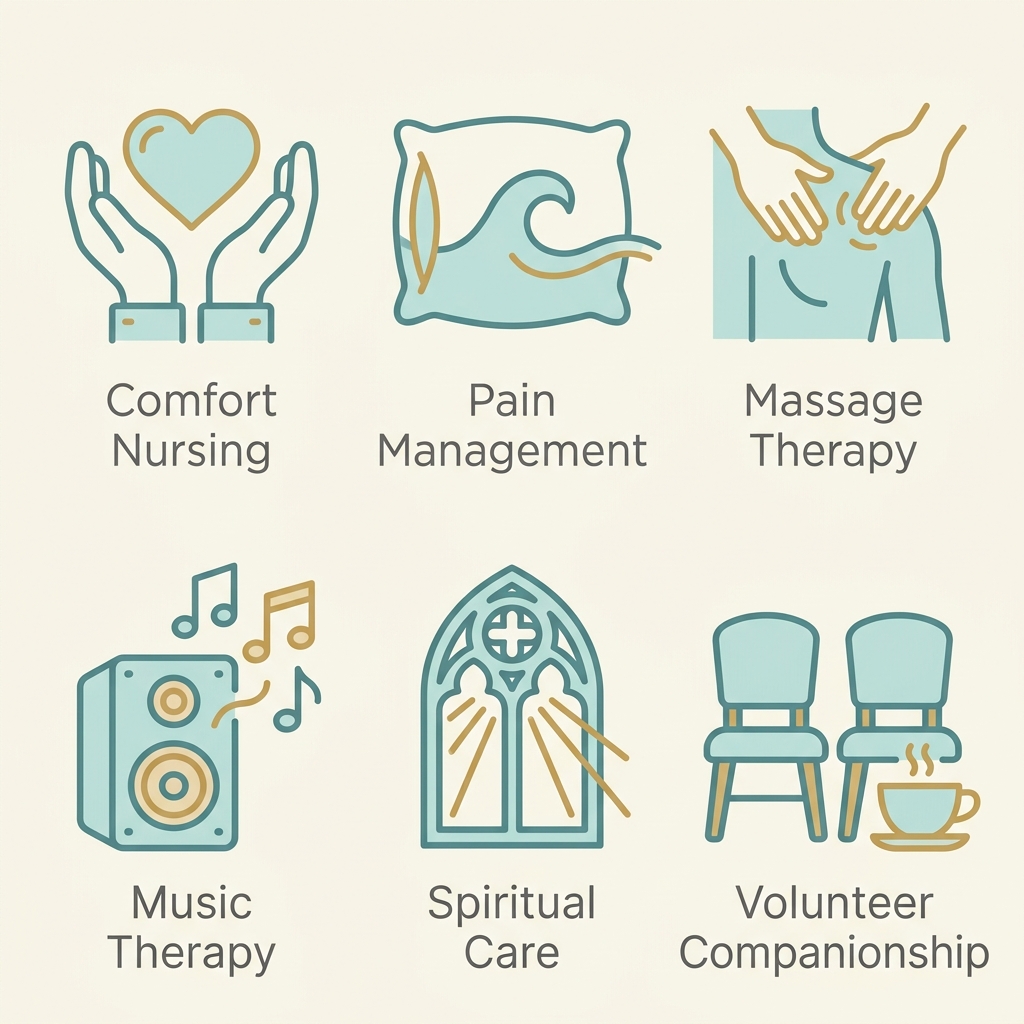
When families in Saginaw know what kind of care they want for their loved one, comfort is the goal everyone is working toward. We focus our care on whole-person comfort, both the physical and the emotional and the spiritual. Because hospice isn’t about curing anything, when families compare home health vs hospice, they find that comfort care is the better choice for their loved one’s last months. Our interdisciplinary team, which includes physicians, nurses, social workers, chaplains, and therapists, is committed to managing pain, lessening anxiety and honoring patients’ beliefs. In addition, our team provides alternative therapies like massage and music therapy to soothe the body and lift the spirit, while trained volunteers provide companionship and respite for caregivers.
This ensures our patients live their remaining time with dignity and peace.
3. Nursing Support Tailored to the Moment
At Amara Hospice Care in Michigan we provide our nursing and aide support on a per patient basis, adapting to their needs in real time. Our team provides clinical nursing and pain management as part of our interdisciplinary approach so that your loved one has comfort and dignity every step of the way.
Our certified aides assist with daily living tasks such as bathing, grooming, getting dressed and toileting to maintain hygiene and comfort. They also support safe mobility—walking with aids and helping with bed-to-chair transfers—to reduce fall risks. Aides observe changes in comfort, breathing, or appetite and promptly report them to our registered nurses, so care plans adjust quickly.
Rather than differentiating home health vs hospice nursing for families, our focus stays on comfort and quality of life, not treatment. Every time we visit, we adjust to the situation at hand, guided by individualized, culturally sensitive care plans that evolve as needs change.
4. Simpler Eligibility You Can Trust
We understand that families often wonder if hospice is appropriate for their loved one. What we’re looking for are simple signs like frequent trips to the emergency room, unexpected weight loss, a lot of falls, having to be helped with daily activities, or shortness of breath during rest. This doesn’t mean a certain diagnosis, but these signals might be enough to prompt us to ask whether hospice support would be beneficial.
Our team can help explain the differences between hospice and other types of home-based care. Unlike home health that revolves around recovery or maintenance, hospice is all about team oriented pain and symptom management with an end of life focus. While palliative type support may help with suffering along the way of the disease, our hospice eligibility centers on end of life supportive care focused on keeping your loved one as comfortable as possible in their own home.
You can ask for a free professional assessment via our online inquiry form to find out if hospice is right for you.
5. Financial Confidence with Medicare
Once the family has established their eligibility, many families in Saginaw also ask about the cost. Medicare, Medicaid, and most private insurance plans cover home hospice services in Michigan, so families we serve pay little to nothing for their care.
We coordinate with Medicare to make sure families know what is covered (from 24/7 on-call support to medication management to medical equipment), so that they can focus on what matters most to them. With roughly 99% of beneficiaries qualifying for premium-free Part A based on their work history, many families already have the coverage that is necessary for hospice.
To help put this in some context, the current standard Medicare Part B monthly premium is $209.40 for 2027 and the annual deductible is $292, which gives you a good idea of what we’re talking about when we refer to routine costs. With finances taken care of, now our care team can think about how they’ll all work together to care for your loved one.
6. Coordinated Care When You Need Both
Learning about home health vs hospice can help families see how these services can work together to support a loved one’s comfort and dignity. At Amara Hospice Care, our team includes physicians, social workers, chaplains and trained volunteers who work together to deliver seamless care across homes, assisted living facilities, and hospitals in Saginaw County and greater Detroit.
We customize pain management to your patient’s comfort plan including oral, injectable and transdermal medication. We offer alternative supports like massage therapy and music therapy as well as bereavement counseling for patients’ families to ensure their comfort is not only physical, but also emotional and spiritual. Available at all times, the 24/7 on-call service center is always there if needed in case of emergencies, so families don’t feel alone during a crisis.
While hospice is a team-based approach to pain management and emotional support at the end of life, palliative care treats suffering in all its aspects at any stage of a serious illness. Used together, they form a plan that changes as your loved one’s needs change.
Recognizing When Care Needs Change
Even the most attentive care plans must adapt as a loved one’s condition shifts. Families often wonder about home health vs hospice when needs change, and noticing these shifts is the first step toward getting the right support.
Red flags you should speak to your doctor about include frequent hospitalizations, weight loss, or falling down often. Shortness of breath without being active and needing help with things like bathing, getting dressed or going from place to place can mean that it’s time for a professional to check them out and offer some additional comfort and safety. This isn’t something to freak out over, but it’s something to take a look at as a moment where we can ask if all aspects of our whole-person care, including daily living tasks, are serving body and soul.
Write down what you notice, so you can discuss it in your assessment. Our team will work to clarify things for you, in as clear a manner and with as much compassion as possible.
8. Support That Never Sleeps
If your loved one’s needs change during the quiet hours, you don’t need to wait until morning to get help. At Amara Hospice Care our team is available 24 hours a day, every day of the year, to connect families in Saginaw County and beyond with a professional on-call nurse, social worker, chaplain or grief counselor when needed.
Unlike home health, which is all about medical treatment and healing, hospice care is about being comfortable and dignified in the midst of life-limiting illness. Our on-call service connects you directly to your nighttime team, the same team that does our visits during the day with nurses for managing symptoms, social workers for help with practical issues, chaplains to offer spiritual comfort, and counselors for grieving, so any urgent needs get the same level of care we give our planned care.
Should there be an urgent matter, please call our on-call line 24/7 at 989.200.5000 or take our free online assessment to receive compassionate guidance about what is next for your family.
Frequently Asked Questions
Is a terminal diagnosis required to qualify for hospice care versus home health?
Hospice care does not require a specific diagnosis but focuses on comfort when a physician determines a life expectancy of six months or less. Home health focuses on recovery or maintenance, not end-of-life care.
What is the main difference between home health care and hospice care?
Home health care aims for clinical recovery or maintenance with skilled nursing and therapy, while hospice care provides comfort-focused support for patients with life-limiting illnesses. Hospice includes pain management, emotional, and spiritual care.
Can a patient receive both home health and hospice care at the same time?
Patients can receive both services simultaneously, as home health focuses on recovery and hospice on comfort. Amara Hospice Care coordinates care to support comfort and dignity without conflict.
How do I know if my loved one is ready to transition from home health to hospice?
Signs include frequent hospitalizations, significant weight loss, frequent falls, needing help with daily activities, or shortness of breath at rest. These indicators suggest hospice may improve comfort and quality of life.
Does Medicare cover home health and hospice services differently?
Medicare, Medicaid, and most private insurance plans cover home hospice services in Michigan, including 24/7 on-call support, medication management, and medical equipment. Coverage details are coordinated with Medicare to minimize out-of-pocket costs.
Compassionate Guidance for Your Next Step
Choosing between home health and hospice can be really confusing, but we also know that families don’t just want facts, they want compassion too. We are here for you, to help guide you through it all, and provide the support and comfort you need in this time.
Each step brings comfort and dignity, with around-the-clock care provided by our interdisciplinary team. A physician will also help decide whether or not hospice is right for your loved one.
If you’re interested in seeing what’s best for your family, give us a call for a free assessment. Medicare, insurance and other documentation may be required. Call 989.200.5000 or email info@amarahospicemi.com — we are here to assist you.
Request Your Free Hospice Assessment
You’ve now seen how comfort-focused hospice care compares with other home-based options, from whole-person support to around-the-clock nursing. The signs we outlined — frequent hospitalizations, weight loss, falling, or shortness of breath at rest — are worth writing down to discuss with a professional. A free assessment can bring clarity about which care path fits your loved one’s situation. Families in Saginaw County and the greater Detroit area can reach us at 989.200.5000 or by email at info@amarahospicemi.com. A physician will help determine whether hospice is right for your loved one, so you never have to make that call alone. Request your free assessment today. Compassionate guidance for your family’s next step starts with one simple conversation.