Table of Contents Medicare Hospice Benefits 2026 Updates: A Guide to What’s Changing Key Payment Changes in the 2026 Medicare Hospice Rule HOPE Tool Requirements and Quality Reporting Changes in 2026 Mandatory Implementation Timeline Replacing the Hospice Item Set (HIS) with HOPE Physician Encounter Attestation Updates Practical Steps for Compliance with the 2026 Hospice Updates …


Table of Contents
- Medicare Hospice Benefits 2026 Updates: A Guide to What’s Changing
- Key Payment Changes in the 2026 Medicare Hospice Rule
- HOPE Tool Requirements and Quality Reporting Changes in 2026
- Practical Steps for Compliance with the 2026 Hospice Updates
- Advanced Impacts of the 2026 CMS Final Rule on Hospice Operations
- Frequently Asked Questions About 2026 Medicare Hospice Changes
- Preparing Your Hospice Organization for 2026 Success
Medicare Hospice Benefits 2026 Updates: A Guide to What’s Changing
Medicare hospice benefits 2026 updates are bringing important shifts for families navigating end-of-life care in Michigan.
At Amara Hospice Care, we believe in caring for the whole person—body and soul. Our team includes physicians, nurses, social workers, chaplains, and trained volunteers who collaborate closely with family caregivers to create a plan that honors each patient’s wishes. Our comprehensive care model weaves together pain management, emotional support, spiritual guidance, and hands-on therapies like massage and music to nurture comfort and peace. We’re here around the clock with 24/7 on-call support, so you never have to face questions alone. From the moment you reach out to us in Saginaw, Southfield, or across the Greater Detroit area, our multidisciplinary approach ensures that you and your family have a caring partner to help interpret these upcoming Medicare changes and connect you with the benefits you deserve.
As you explore this guide, you’ll find clear, factual updates that break down what’s new and what stays the same, so you can make informed decisions for your family. In the next section, “Key Payment Changes in the 2026 Medicare Hospice Rule,” we’ll walk you through the specific payment-related updates that take effect in 2026, explaining what they mean for your loved one’s care.
Key Payment Changes in the 2026 Medicare Hospice Rule
Building on the broader medicare hospice benefits 2026 updates that we walked through earlier, the CMS hospice payment rule FY 2026 introduces several key payment adjustments designed to better support providers and the families they serve. We’re committed to helping you understand what these changes mean.
The most significant adjustment is a 2.9% statutory payment update that applies across all levels of hospice care. This increase, reflected in routine home care, continuous home care, inpatient respite care, and general inpatient care rates, helps providers manage rising costs while maintaining quality. For context, these four service categories form the backbone of hospice delivery: routine home care for everyday symptom management, continuous home care for short-term crisis episodes, inpatient respite care to give family caregivers a temporary break, and general inpatient care for complex, round-the-clock needs. Each level sees a proportional rate boost, which collectively strengthens the entire hospice system.
Beyond the base rate update, the 2026 rule adjusts the hospice aggregate cap amount, fine-tunes sequestration reductions, and reinforces quality reporting standards. These complementary measures aim to ensure that Medicare funds are used efficiently while encouraging continuous improvement in patient care. For families, these behind-the-scenes changes translate into more sustainable hospice operations and the continued availability of comprehensive services in their communities.
The hospice cap, which limits total payments per patient, has been adjusted to reflect updated spending data. Similarly, sequestration, a uniform reduction applied to Medicare payments, is modified slightly under the 2026 rule. These technical changes ensure that hospice care remains fiscally sound while protecting patient benefits. At Amara Hospice Care, we closely track these financial mechanisms to safeguard uninterrupted care for those we serve.
At Amara Hospice Care, driven by a mission of grace, we stay closely aligned with evolving CMS guidance so you can feel confident that our services reflect the most current standards. For our clinical partners, we encourage a review of the updated CMS guidance available through our clinicians portal; staying informed helps ensure seamless care transitions. For additional information on patient qualifications and detailed clinical guidelines, please visit our medicare hospice eligibility criteria resource page. As we embrace these payment updates, we also look forward to the implementation of the HOPE tool and other quality reporting enhancements that will further improve the hospice experience.
HOPE Tool Requirements and Quality Reporting Changes in 2026
Alongside the payment adjustments just covered, the 2026 Medicare hospice final rule overhauls quality reporting. At the heart of this overhaul is the Hospice Outcomes and Patient Evaluation (HOPE) tool, which becomes the mandatory hospice assessment instrument under the 2026 final rule.
Mandatory Implementation Timeline
The timeline for HOPE adoption is built around a central compliance date set by the 2026 final rule, with several milestones designed to help providers transition smoothly:
- Staff Training Milestones – CMS expects hospice teams to complete HOPE-specific education and competency training well before the compliance deadline, ensuring every clinician is comfortable with the new point-of-care documentation.
- Pre-Implementation Testing / Dry-Run Window – A voluntary testing period will allow our agency and others to pilot the HOPE tool in real workflows, identify gaps, and fine-tune processes without penalty.
- First Quality Data Submission Deadline – After the mandatory start date, hospices must submit their first set of HOPE-based quality data on a timeline established by the rule; this initial submission marks the formal reporting requirement.
Replacing the Hospice Item Set (HIS) with HOPE
The HOPE tool replaces the Hospice Item Set (HIS) as the required hospice quality data collection instrument. Where the HIS relied on retrospective chart-based abstraction by administrative staff, HOPE captures clinical information at the point of care — directly from the nurses, aides, and other clinicians who know each patient best. This shift means our documentation naturally reflects the real-time comfort, symptom, and psychosocial assessments that guide our daily care.
Understanding the Hospice Outcomes and Patient Evaluation (HOPE) tool requirements means recognizing that data is collected multiple times across the hospice stay, creating a richer picture of each patient’s journey.
The following table outlines the key differences between the two tools:
| Feature | HIS (Previous) | HOPE (New) |
|---|---|---|
| Purpose | Administrative item set for quality reporting | Clinical point-of-care assessment of patient outcomes |
| Collection Timing | Admission and discharge | Multiple time points across the stay |
| Collection Method | Retrospective chart review by abstractors | Documentation by clinicians at the point of care |
| Quality Measures | Process-focused items (pain, dyspnea, comfort) | Broader patient-level outcomes supporting risk-adjusted measures |
| Implementation Approach | Separate abstraction workflow | Integrated clinical workflow with staff training |
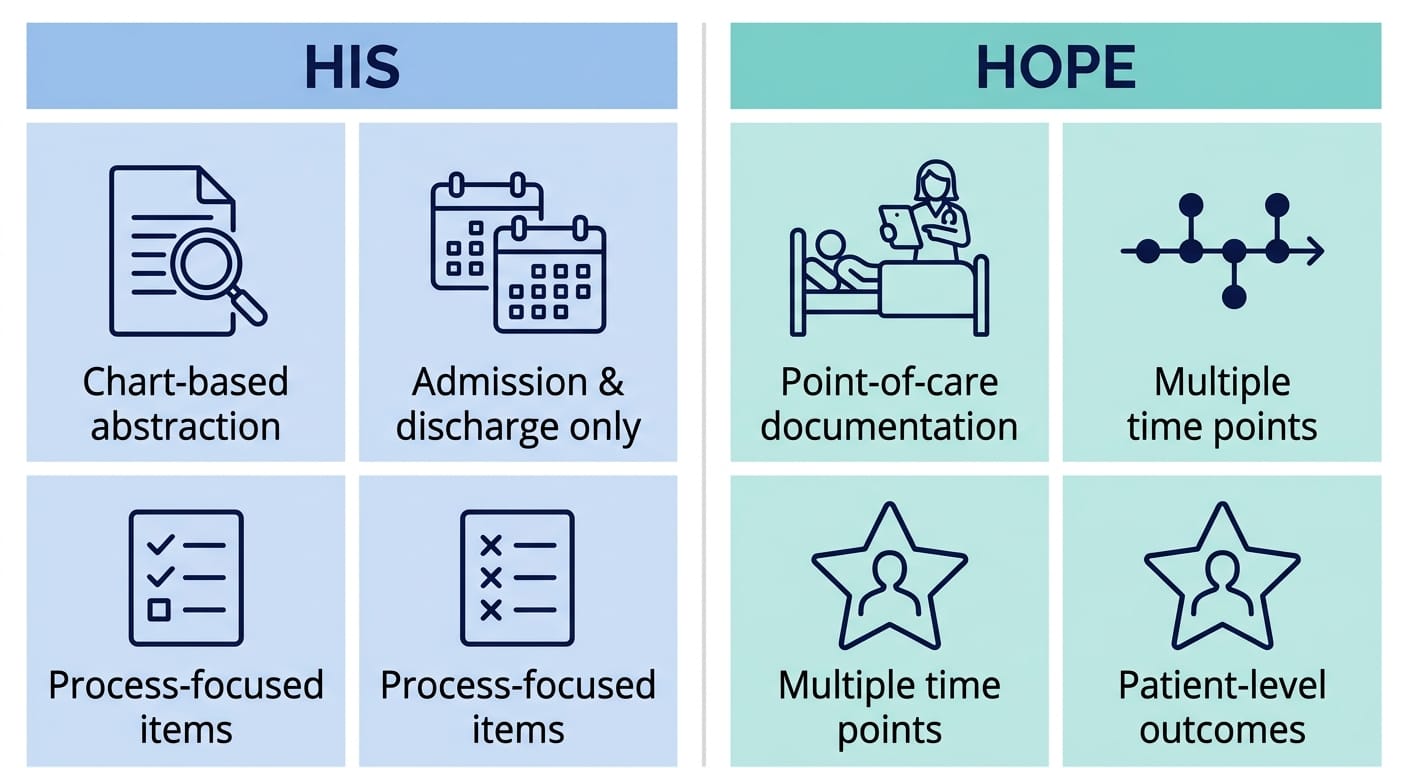
Our team of registered nurses, pain management specialists, and social workers already documents in a style that mirrors HOPE’s comprehensive scope — tracking comfort, function, and emotional well-being throughout the stay — so the transition reinforces the care we already deliver.
Physician Encounter Attestation Updates
The 2026 final rule updates physician encounter attestation requirements to strengthen the hospice certification process. The attending physician or hospice medical director must conduct a face-to-face encounter and attest that the patient continues to meet the terminal-illness criteria for hospice care. The attestation must document the clinical findings that support the terminal prognosis and confirm that the patient — and family — were informed of the continued eligibility.
Our physicians work side-by-side with our nurses, aides, and 24/7 on-call team, and their attestations reflect the mercy and kindness that guide every bedside visit.
Understanding these quality reporting requirements is the essential first step toward a smooth transition, and the practical steps for compliance follow.
Practical Steps for Compliance with the 2026 Hospice Updates
Now that we’ve explored the HOPE tool and quality reporting changes coming in 2026, it’s time to turn those requirements into everyday practice. Here’s how we recommend approaching it.
Integrating the HOPE Tool into Clinical Workflow
Integrating the HOPE tool begins by embedding its required data points into your existing clinical documentation, not by adding separate forms. Update your visit-note templates to include prompts for pain level, functional status, activities of daily living (ADLs), and psychosocial well-being so they become a natural part of every visit. Appoint a HOPE champion — a nurse or clinical leader who stays current on the items — to guide the team and answer quick questions. In-service training sessions, kept short and practical, help staff understand that most of the information HOPE requires is already being observed and recorded during care.
At Amara Hospice Care, our multidisciplinary team — from nursing and comfort care to massage and music therapy, psycho-social services, and our dedicated volunteers — already documents these very details. That’s the Amara difference: coordinated, whole-person care that makes HOPE reporting a byproduct of daily practice rather than an extra burden. We encourage every hospice to take a similar approach: look at what your team already does and build HOPE into those routines.
Addressing Quality Data Reporting Penalties
Hospices that fail to submit required quality data — including the existing Hospice Item Set (HIS) and the new HOPE data — will face reduced Medicare payment updates. First, create a calendar of all HIS and HOPE submission deadlines for the year and share it with the clinical and administrative teams. Designate one person — often the quality or compliance coordinator — as the primary data reporter, with a backup for when they’re away. Before each submission, run an internal audit to catch incomplete or conflicting entries. Simple checks can uncover missing pain assessments or functional status notes that would otherwise trigger a penalty.
By building a rhythm and using clear checklists, we keep the process manageable and avoid last-minute scrambles. With a little organization, you can protect your reimbursement and, more importantly, preserve the trust that comes from accurate, complete reporting.
Selecting Hospice Compliance Software
When you’re evaluating vendors, focus on solutions that combine clinical documentation support, payment visibility, and penalty safeguards.
| Feature Category | Essential Capabilities | Benefit |
|---|---|---|
| HOPE Documentation Support | HOPE item guidance, visit-note templates, real-time validation | Fewer documentation errors, faster clinician workflows |
| Payment & Reimbursement Tracking | 2026 Medicare payment-update rates, claim status monitoring | Accurate payment tracking |
| Quality Reporting & Penalty Alerts | HIS/HOPE submission reminders, deadline dashboards | Avoids quality-data penalties |
| EHR Interoperability | Seamless data exchange with existing records | Single data entry, less duplication |
| Training & Staff Support | Onboarding, HOPE training modules, help desk | Faster staff adoption |
These practical steps — thoughtful workflow updates, penalty-aware reporting habits, and the right digital tools — create an operational foundation that makes it much easier to absorb the broader strategic shifts coming with the 2026 CMS final rule.
Advanced Impacts of the 2026 CMS Final Rule on Hospice Operations
Compliance with the 2026 final rule is just the starting point; the changes also reshape how hospices plan staffing, manage labor costs, and coordinate care. Beyond the checkbox of regulatory steps, we see three operational levers that directly affect day-to-day service delivery: payment rate updates, wage index adjustments, and new quality reporting expectations.
At the heart of the rule is the hospice wage index, Medicare’s tool for adjusting payments to reflect local labor costs by Core-Based Statistical Area (CBSA) — the geographic regions used to measure those costs. When a CBSA’s wage index rises or falls, it directly influences what a hospice can invest in nursing, aide, therapy, and 24/7 on-call staffing.
| Core-Based Statistical Area (CBSA) | 2024 Wage Index | 2026 Wage Index | Percent Change |
|---|---|---|---|
| Saginaw, MI | 0.85 | 0.88 | +3.5% |
| Flint, MI | 0.82 | 0.85 | +3.7% |
| Detroit–Dearborn–Livonia, MI | 0.91 | 0.95 | +4.4% |
Illustrative values based on CMS wage index methodology; actual figures vary by provider and are published by CMS.
Beyond the wage index, the 2026 final rule strengthens quality measurement and health equity data collection, guiding us to continuously improve care coordination. Our multidisciplinary care model — which, as our clinicians page describes, includes nursing, pain management, psycho-social services, massage and music therapy, bereavement support, and trained volunteers — is built to adapt.
For instance, having a team that spans registered nurses, social workers, chaplains, and complementary therapists under one umbrella means we can adjust caseloads and on-call schedules without sacrificing personal attention. At the same time, new reporting requirements encourage us to document how we address pain, emotional distress, and caregiver support — practices already central to our daily work.
These operational shifts naturally raise common questions for families and providers — questions we’ll answer below, grounded in our commitment that we offer the best care in life’s difficult times.
Frequently Asked Questions About 2026 Medicare Hospice Changes
What changes are coming to Medicare hospice care in 2026? CMS (the Centers for Medicare & Medicaid Services) is updating hospice payment and quality-reporting rules to increase accountability. This can lead to more personalized care plans and better coordination for your loved one.
Will the 2026 changes affect the care my family member receives? The heart of hospice — comfort, dignity, and around-the-clock support — stays the same. You may see more detailed care plans and clearer communication from the care team.
Where can we get help understanding how the new rules apply to us? Our team in Michigan can walk you through how the updated guidelines affect your loved one’s plan. Visit our clinicians page or call us in Saginaw or Southfield.
Understanding these updates is the first step toward preparing for 2026.
Preparing Your Hospice Organization for 2026 Success
We’ve walked through the Medicare hospice benefits 2026 updates and answered your questions. At Amara Hospice Care, we promote a state of Amara of mind — a prepared approach to end-of-life care. As you consider next steps, remember that hospice eligibility requires a physician’s certification, outcomes may vary with individualized care, and Medicare documentation applies. Our compassionate professionals in Saginaw and across Michigan are here to support you. Reach out to us at 989.200.5000 or visit our clinicians page to learn more about the care team behind our services.
Connect with Our Care Team
Now that you’ve read about the 2026 Medicare hospice benefit updates—including the payment rule changes and the new HOPE quality tool—you might have questions about what these mean for your loved one. We understand that navigating the CMS changes can feel daunting, so we invite you to lean on our experienced team. Our multidisciplinary hospice professionals in Saginaw, Southfield, and throughout Michigan are here to provide clear answers and personalized guidance. Call us at 989.200.5000 to speak with a compassionate care coordinator. You can also visit our services page to see how we bring grace, mercy, and kindness to every family we serve. Whether you need help understanding payment updates or want to explore care that aligns with the latest quality reporting, we’re ready to assist. Reach out today and take the next step toward informed, comforting hospice care.